
Fractional vs Decimal Odds: Betting Format Conversion
 Available in US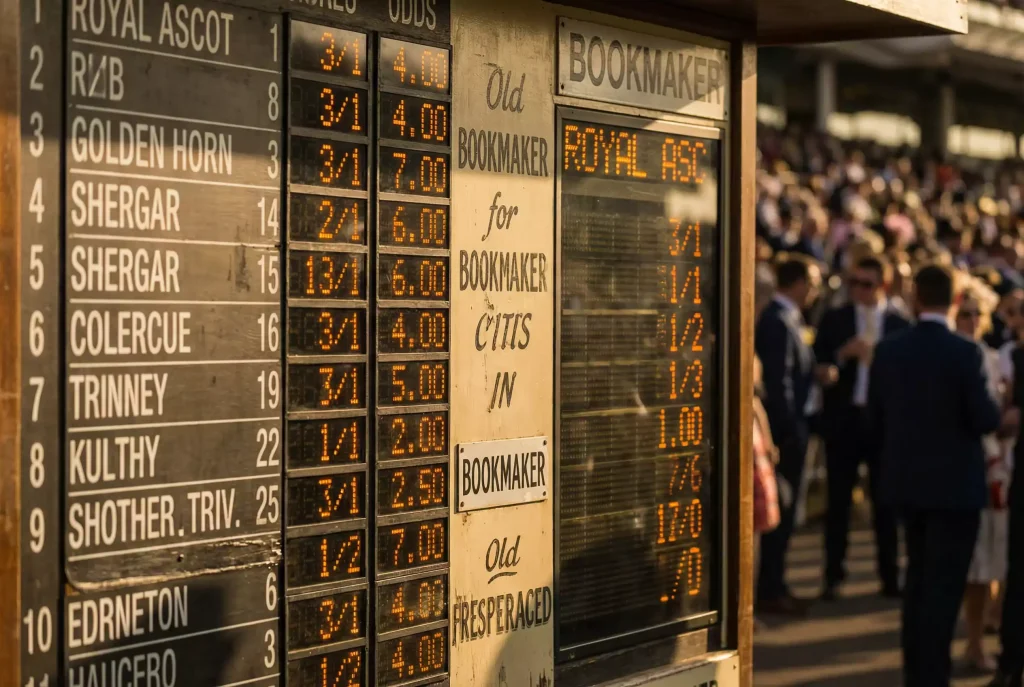
Two Languages for the Same Information
Horse racing betting in the UK generated gross gambling yield of £766.7 million in the 2026-2026 financial year, according to the Gambling Commission. Every single bet in that figure was expressed as odds — and yet not every punter was looking at the same format. Some saw 5/1. Others saw 6.00. Same horse, same race, same potential payout. Different notation.
Fractional odds are the traditional British format, familiar to anyone who’s ever watched coverage from Ascot or walked into a William Hill shop. Decimal odds dominate continental Europe, Asian markets, and most betting exchanges. If you’re serious about horse racing, you’ll encounter both regularly — especially if you use platforms like Betfair, which default to decimal, or compare prices across international bookmakers.
The underlying mathematics is identical. What changes is presentation. Once you understand how each system works and how to convert between them, you’ll read either format instinctively. This isn’t abstract theory; it’s practical skill that affects how quickly you can assess value and place bets.
Fractional Odds Deep Dive
Fractional odds have been the standard in British racing for centuries. The format is simple: the first number represents your potential profit, the second represents your stake. At 5/1, you win five pounds for every one pound wagered. At 1/2, you win one pound for every two staked. The numbers tell you the relationship between profit and risk.
Reading them correctly is largely a matter of pattern recognition. Odds where the first number exceeds the second — 3/1, 7/2, 10/1 — are “odds against.” The horse is considered less likely to win than lose, so the payout rewards the risk. Odds where the first number is smaller — 1/2, 4/9, 1/5 — are “odds on.” These horses are strong favourites, expected to win, and the returns reflect that reduced risk.
Some fractional odds look awkward until you work them through. At 11/4, you’re winning £11 for every £4 staked. A £20 bet would return £55 profit plus your £20 stake, totalling £75. At 6/4, often called “six to four” or “six to four on,” you win £6 for every £4 wagered. A £10 stake returns £15 profit plus £10 back — £25 total. The arithmetic becomes automatic with practice.
To calculate implied probability from fractional odds, divide the second number by the sum of both numbers. At 4/1, that’s 1 divided by 5, giving 0.20 or 20%. At 1/1 (evens), it’s 1 divided by 2, or 50%. At 1/4, it’s 4 divided by 5, or 80%. This probability represents what the market suggests about the horse’s chance — with a margin built in for bookmaker profit, but that’s a topic for another day.
The fractional format has one quirk that trips up newcomers: non-intuitive fractions. Is 5/2 better or worse than 9/4? (5/2 is 2.5 times your stake as profit; 9/4 is 2.25 times. So 5/2 is slightly better odds.) Is 11/8 longer than 6/4? (11/8 is 1.375 times; 6/4 is 1.5 times. So 6/4 is actually shorter odds, meaning a higher implied probability.) These comparisons become instinctive, but only after deliberate practice.
Decimal Odds Explained
Decimal odds represent total returns per unit staked, including your stake. At 6.00, a £1 bet returns £6 total — five pounds profit plus your one pound back. At 2.50, you receive £2.50 back per pound, meaning £1.50 profit. The stake is already factored into the number, which simplifies certain calculations.
The mathematics of decimal odds is straightforward. Multiply your stake by the decimal to get total returns. A £25 bet at 3.40 returns £85 (25 × 3.40). Your profit is £60 (returns minus stake). To calculate implied probability, divide 1 by the decimal. At 4.00, that’s 1 ÷ 4 = 0.25 or 25%. At 2.00, it’s 50%. At 1.25, it’s 80%.
Decimal odds make comparisons instant. Is 4.50 better than 4.20? Obviously yes — the bigger the decimal, the bigger the payout. This eliminates the mental gymnastics required when comparing 7/2 against 15/4. Both represent roughly similar odds, but seeing 4.50 versus 4.75 makes the difference immediately clear. For anyone using exchange platforms where prices fluctuate by the second, this clarity matters.
One adjustment British punters must make: decimal odds of 2.00 equals evens, not 1/1 converted differently. And odds-on bets sit between 1.00 and 2.00. A 1.50 decimal is equivalent to 1/2 fractional — you’re risking two to win one. The closer to 1.00, the stronger the favourite and the smaller the potential profit.
Quick Conversion Methods
Converting between formats is simple arithmetic once you know the formulas. To convert fractional to decimal, divide the first number by the second, then add one. At 5/1, that’s (5 ÷ 1) + 1 = 6.00. At 9/4, it’s (9 ÷ 4) + 1 = 2.25 + 1 = 3.25. At 1/2, it’s (1 ÷ 2) + 1 = 0.5 + 1 = 1.50.
To convert decimal to fractional, subtract one, then express as a fraction. At 4.00, that’s 4.00 – 1 = 3, or 3/1. At 2.50, it’s 2.50 – 1 = 1.50, which is 3/2 (multiply both sides by 2 to clear the decimal). At 1.80, it’s 1.80 – 1 = 0.80, which is 4/5. Some conversions produce fractions not traditionally used — 2.33 becomes 1.33/1 or roughly 4/3. Bookmakers round these to standard fractions, so 2.33 might display as 11/8 or 5/4 depending on the platform.
For implied probability, the formulas differ by format but achieve the same result. Fractional: second number ÷ (first + second). So 3/1 gives 1 ÷ 4 = 25%. Decimal: 1 ÷ decimal. So 4.00 gives 1 ÷ 4 = 25%. Both methods yield identical probabilities because they’re describing the same underlying bet.
Rather than memorising conversions, learn the common anchor points and work from there. Evens is 2.00 decimal. 2/1 is 3.00. 5/1 is 6.00. 10/1 is 11.00. For odds-on: 1/2 is 1.50, 4/5 is 1.80, 4/6 is 1.67. With these reference points fixed, you can estimate most other conversions quickly. A 7/2 is halfway between 3/1 (4.00) and 4/1 (5.00), so it’s roughly 4.50 — in fact, it’s exactly 4.50.
Most betting sites now offer format toggles in settings. You can view every market in your preferred format. But the ability to work in both gives you flexibility when comparing prices across platforms that don’t match your default.
Which Format to Use
The honest answer: use whichever feels more intuitive, but develop fluency in both.
Fractional odds suit traditional bookmaker betting where you’re assessing individual selections and need to quickly grasp profit potential. British racing culture speaks in fractional — “I got 7/2 about him” — and if you’re discussing form with other punters, speaking the local language helps. The format also works well for calculating multiple bets by hand, though that’s less relevant in the age of automatic calculations.
Decimal odds suit exchange trading and rapid price comparison. When you’re watching odds move from 3.45 to 3.50 to 3.55 in seconds, decimal makes the increments visible. Exchanges also allow you to request specific odds (3.48, for instance), which fractional can’t express cleanly. For punters working across multiple platforms, decimal provides a universal currency.
The practical advice: set your primary platform to your preferred format, but don’t avoid platforms that use the other. The betting exchange world — where better odds are often available — runs on decimal. Ignoring it because you’re uncomfortable with the format costs you money over time. Similarly, understanding fractional ensures you can follow British racing coverage, use traditional bookmakers during their price boosts, and participate in the broader culture of UK punting.
Neither format is superior mathematically. They’re notation systems, not betting strategies. The odds themselves matter; how they’re displayed doesn’t affect the underlying probability or value of the bet.
Same Bet, Different Language
Fractional and decimal odds express identical information. A 4/1 shot and a 5.00 shot offer the same payout and imply the same probability. The difference is purely presentational — which is why developing fluency in both formats is valuable rather than picking one and ignoring the other.
For UK punters, fractional remains the default in most contexts: racecourse boards, betting shops, television coverage, and discussions with fellow punters. For exchange trading and international platforms, decimal dominates. Being comfortable in both environments opens more opportunities and allows for faster decision-making regardless of the platform you’re using.
The conversions become automatic with use. After enough exposure, you won’t need to calculate that 7/2 equals 4.50; you’ll simply know it. Until then, the formulas are straightforward: add one to convert fractional to decimal, subtract one to convert the other way. The rest is practice and pattern recognition.
