
Back-to-Lay Trading Systems: Pre-Race Market Tactics
 Available in US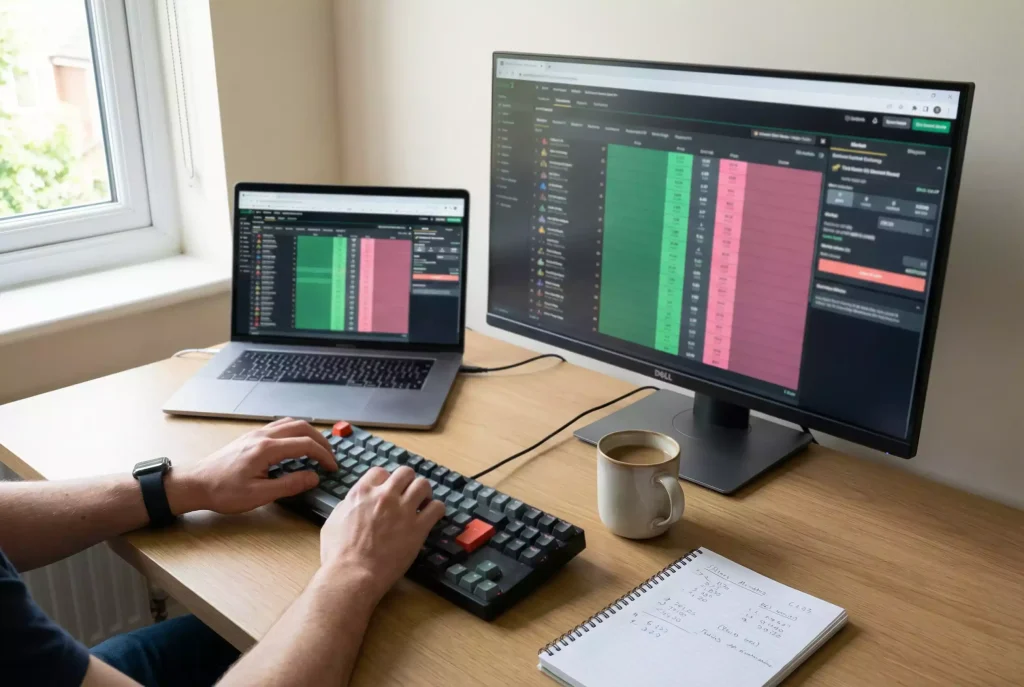
Trading the Market
Back-to-lay trading transforms horse racing from a betting exercise into a market trading opportunity. Instead of picking winners, you identify horses whose prices will shorten, back them at higher odds, then lay them at lower odds to lock in profit regardless of the race result. The horse doesn’t need to win — the price movement alone generates your return.
Trading requires different skills from betting. You need to read markets, anticipate price movements, execute quickly, and manage positions actively. The reward is the possibility of consistent profits without the variance that traditional betting creates. Trade the market, bank the profit — that’s the trader’s approach to horse racing.
How Back-to-Lay Works
The mechanics are straightforward. You back a horse at a certain price — say 6.0 (5/1) — with a £100 stake. If the price then shortens to 4.0 (3/1), you lay the horse at that new price. The lay stake required to fully hedge depends on your back stake and the odds differential. In this example, laying around £150 at 4.0 would leave you with roughly £50 profit regardless of the race result.
The mathematics determines your exact positions. Your back bet wins £500 if the horse wins (£100 at 6.0 = £600 return minus £100 stake). Your lay bet loses £450 if the horse wins (£150 lay stake times 3). Net position if the horse wins: £50 profit. If the horse loses, your back bet loses £100 and your lay bet wins £150. Net position: £50 profit. The trade has succeeded — you’ve “greened up” with guaranteed profit.
Partial trading offers flexibility. Rather than fully hedging for equal profit regardless of result, you can lay less than the mathematically required amount. This leaves you with a larger profit if the horse loses but a smaller profit (or even a small loss) if it wins. Experienced traders use partial trades to maintain some upside when they believe the selection has genuine winning chances beyond the price movement they’ve already captured.
Identifying Price Movements
Successful back-to-lay trading depends on correctly anticipating which horses will shorten in price. Several patterns help identify likely shorteners before the market moves.
Market support from informed sources often precedes price movements. When significant money appears on a horse — especially early in the day before casual punters are active — it suggests confidence from those with inside knowledge or superior analysis. Watching for these early moves, sometimes called “steam,” provides opportunities to follow the money before prices fully correct.
Stable confidence signals through various channels. Trainer comments in the racing press, jockey bookings that suggest serious intent, and reports from morning trackwork all provide hints about which horses connections fancy. A horse talked up by its trainer in previews, ridden by a retained jockey who could have ridden elsewhere, often attracts support that shortens its price.
Elimination of rivals triggers price movements. When a fancied horse is withdrawn, market money redistributes to remaining contenders. If you’ve backed a horse that was second favourite and the favourite scratches, your selection often shortens dramatically. Non-runner announcements can create sudden trading opportunities, though acting quickly is essential as prices adjust rapidly.
Race-day conditions favouring specific runners create price movements. If overnight rain transforms the going and your selection is a proven soft-ground specialist while the favourite wants firm ground, expect your horse to shorten and the favourite to drift. Weather changes in the hours before racing regularly reshape markets in ways attentive traders can exploit.
Timing Your Trades
Entry timing matters more than most traders initially realise. Back too early and you might secure a good price that then drifts before you can lay — turning potential profit into loss. Back too late and the price movement has already occurred, leaving no margin to trade.
The morning markets often offer the best entry points for anticipated shorteners. Prices in morning markets are set by fewer participants and can be inefficient. A horse you expect to be well-supported might trade at 8.0 in the morning but 5.0 by post time. Backing early captures this entire movement. The risk: morning assessments can prove wrong, and prices can drift rather than shorten.
The final hour before racing sees the heaviest trading volume. Prices move quickly as money floods into the market. This period suits experienced traders who can react to real-time information — weather updates, paddock reports, market flows — but overwhelms those unable to process information and execute simultaneously. Many traders focus exclusively on this window, accepting they’ll miss some morning opportunities in exchange for trading on more complete information.
Exit discipline completes the trade. Some traders set target profits and lay automatically when prices reach their threshold. Others watch markets and lay when momentum appears to stall. Either approach can work; what doesn’t work is holding indefinitely hoping for further movement. Markets can reverse, and paper profits can vanish. Taking profit when it’s available, rather than hoping for maximum movement, sustains trading careers.
Tools and Software
Professional trading requires better tools than Betfair’s website provides. Third-party software offers faster execution, ladder interfaces showing depth of market, and automation features that manual trading cannot match. For serious traders, investing in proper tools isn’t optional.
Ladder interfaces display prices in vertical columns, with available money at each price level visible at a glance. This view reveals market depth — whether substantial money backs the current price or it’s thinly supported and vulnerable to movement. One-click betting from ladder interfaces executes trades in milliseconds rather than the seconds required for website navigation.
Automation features allow preset triggers: backing when a horse reaches a certain price, laying when it shortens to a target, or stop-losses that exit positions if prices move against you. These features reduce the emotional element of trading and ensure disciplined execution even when you cannot watch markets constantly. Most successful traders use some level of automation, even if they make primary decisions manually.
Building Trading Skills
Back-to-lay trading offers an alternative path to profitability that doesn’t depend on picking winners. By focusing on price movements rather than race results, traders can generate consistent returns with lower variance than traditional betting. The approach suits those comfortable with markets, quick execution, and active position management.
Start with small stakes while learning. Track every trade, noting entry price, exit price, time held, and profit or loss after commission. Patterns emerge over hundreds of trades — which race types produce the best opportunities, which time windows suit your execution speed, which signals reliably predict movement. Trade the market, bank the profit — but recognise that trading skill develops gradually through practice and careful analysis of results.
