
Matched Betting Systems: Generating Risk-Free Profits
 Available in US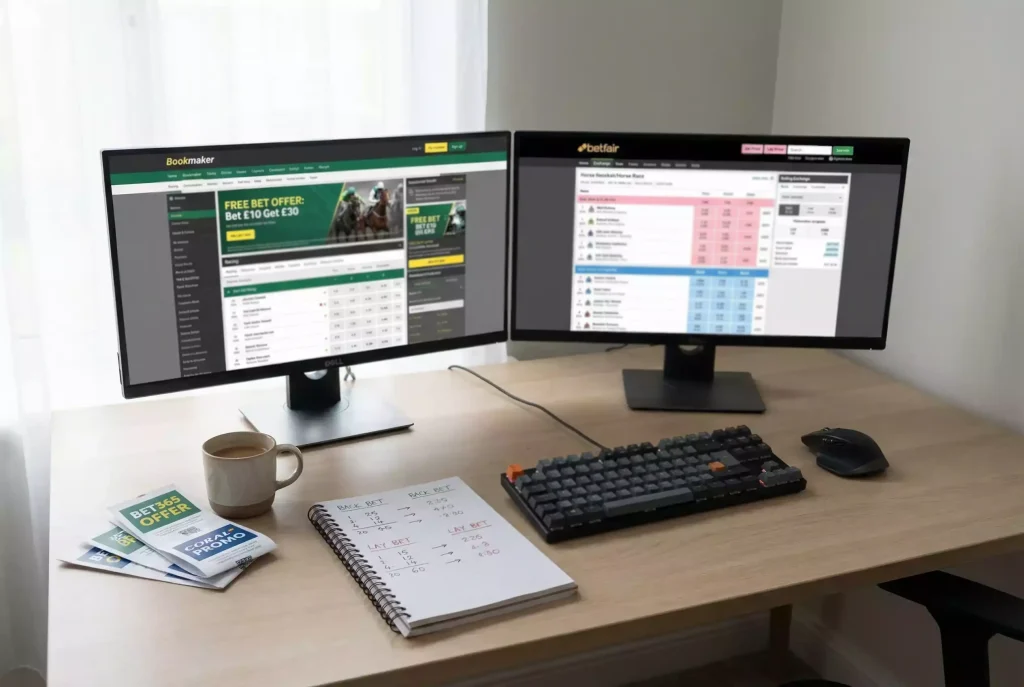
The Mathematical Certainty
Matched betting extracts guaranteed profit from bookmaker promotions. By backing a selection with a bookmaker and laying the same selection on an exchange, you cover all outcomes. The bookmaker’s free bet or bonus provides the profit margin; the exchange lay bet neutralises risk. The result isn’t gambling — it’s mathematical arbitrage applied to promotional offers.
Horse racing offers ideal conditions for matched betting. Liquid exchange markets allow laying at prices close to bookmaker odds. Numerous racing-specific promotions run daily — free bets on certain races, money-back offers if your horse finishes second, enhanced prices on festival favourites. Each promotion presents an extraction opportunity for those who understand the mechanics.
How Matched Betting Works
The core concept involves two simultaneous bets that cancel each other. You back a horse at a bookmaker — say £10 at 5.0 (4/1). Simultaneously, you lay the same horse on an exchange at similar odds. If the horse wins, your back bet pays £40 profit; your lay bet loses approximately £40 liability. If the horse loses, your back bet loses £10; your lay bet wins approximately £10. Either way, the outcome is roughly neutral.
Free bet extraction generates profit. Once you’ve qualified for a free bet — say £10 — you repeat the process. Back with the free bet, lay on the exchange. When the free bet wins, you keep the profit minus lay liability. When it loses, your lay bet wins. Either way, you extract roughly 70-80% of the free bet’s face value as guaranteed profit. A £10 free bet typically yields £7-8 profit regardless of outcome.
The mathematics are deterministic. Unlike actual gambling where outcomes determine results, matched betting produces predictable returns. You know before placing bets approximately how much profit will result. This predictability makes matched betting more like completing a task than gambling — execute correctly, extract the value, move to the next promotion.
Types of Promotions
Welcome offers provide the largest individual opportunities. Most bookmakers offer new customers £20-50 in free bets upon sign-up, sometimes more with enhanced terms. Across dozens of UK bookmakers, total welcome offer value can exceed £1,000. Extracting these offers systematically requires multiple accounts but generates substantial one-time profit.
Reload offers recur for existing customers. Free bet clubs offer weekly bonuses for meeting betting thresholds. Money-back specials refund stakes if certain conditions occur — your horse finishes second, loses by a nose, falls at the last. Enhanced odds boosts offer better prices on selected events. These ongoing promotions provide sustainable income after welcome offers are exhausted.
Horse racing generates abundant promotions. Best Odds Guaranteed upgrades returns when SP exceeds your take price. Extra places pay more positions each-way. Festival specials during Cheltenham, Royal Ascot, and major meetings offer enhanced value. Refund offers on specific races create risk-free opportunities. The sport’s popularity ensures bookmakers compete aggressively with racing-specific promotions.
Promotion calendars vary by bookmaker. Some offer consistent weekly free bets; others concentrate promotions around major sporting events. Tracking which bookmakers offer what, and when, helps prioritise activity toward highest-value opportunities. Matched betting communities maintain databases of current promotions, reducing research time for participants.
Execution Step by Step
Identify a qualifying promotion — for example, “Bet £10, get £10 free bet.” Find a horse race with tight spreads between bookmaker back odds and exchange lay odds. Odds close to each other minimise qualifying loss; wider spreads increase the cost of unlocking the free bet.
Place the qualifying back bet with the bookmaker at the promotional terms. Immediately place a lay bet on the same horse at the exchange for an amount calculated to neutralise outcomes. Matched betting calculators automate this calculation — input back stake, back odds, and lay odds to receive exact lay stake required.
Wait for the race result. Regardless of outcome, your position is approximately neutral with small qualifying loss. The bookmaker credits your free bet according to their terms — sometimes immediately, sometimes after settlement. Verify the free bet appears in your account before proceeding.
Extract the free bet using the same process. Back a horse with the free bet; lay on the exchange. Free bets typically return only profit, not stake, so calculations differ from qualifying bets. Use appropriate calculator settings for “stake not returned” free bets. When settled, the free bet value minus lay liability minus commission equals your profit. Transfer profits to your bank; the extraction is complete.
Sustainability and Risks
Account restrictions threaten long-term sustainability. Bookmakers identify matched betting patterns — unusual betting behaviour, rapid promotion extraction, betting only on high-liquidity events — and restrict accounts accordingly. Restricted accounts receive reduced stakes limits or exclusion from promotions. Managing accounts to avoid obvious patterns extends their useful life.
Gubbing — industry slang for account restriction — affects nearly all active matched bettors eventually. Some accounts last months; others are restricted after single welcome offers. Diversifying across many bookmakers provides resilience against individual restrictions. When one account is gubbed, others remain productive.
Human error creates actual risk. Placing back without lay, miscalculating stakes, or misreading promotion terms can produce losses. Double-check every calculation before placing bets. Use calculators rather than mental arithmetic. Read promotion terms carefully — conditions like minimum odds or excluded markets can void expected value if overlooked.
Bankroll management matters even for risk-free activity. Exchange lay bets require sufficient balance to cover potential liability. A £50 lay at 5.0 requires £200 available to cover the worst case. Starting with adequate exchange float — at least £200-500 — prevents being unable to execute due to insufficient funds.
The Promotion Hunter’s Approach
Matched betting transforms bookmaker marketing spend into punter profit. The mathematics guarantee outcomes; execution determines how much value you extract. Start with welcome offers to build capital and skills, then progress to reload promotions for ongoing income.
The approach requires time, attention, and multiple accounts. It isn’t gambling — it’s systematic exploitation of promotional structures. Account restrictions eventually limit activity, but careful account management extends productive life. For those willing to learn the mechanics and execute carefully, matched betting provides genuine risk-free returns that complement or replace traditional betting activity.
