
Betting Exchanges Compared: Betfair, Betdaq, and Smarkets
 Available in US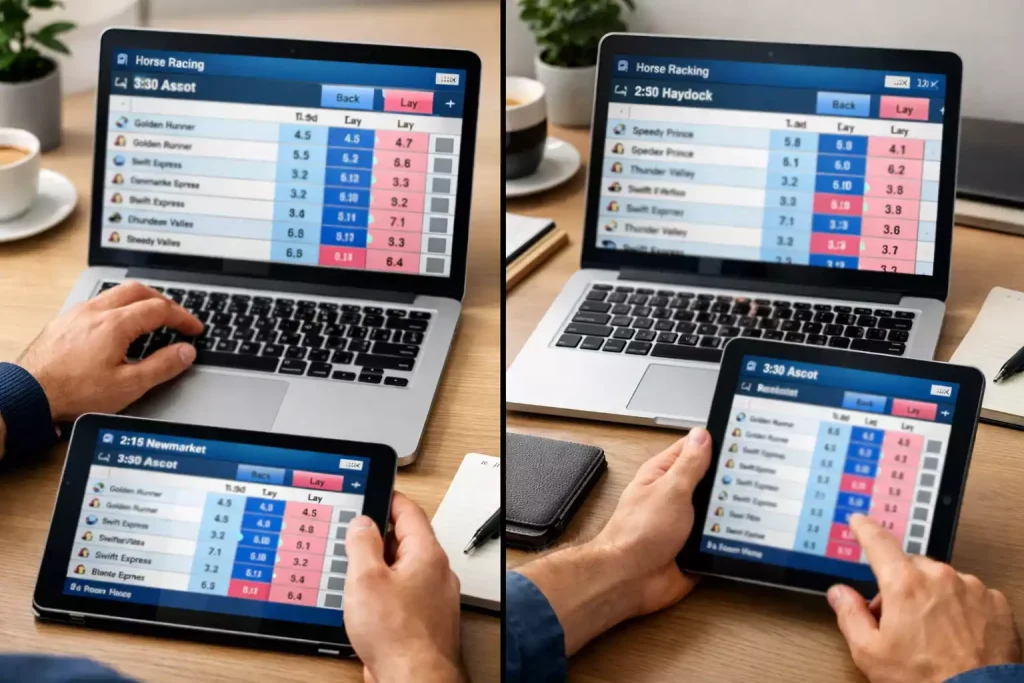
The Exchange Alternative
Betting exchanges let punters bet against each other rather than against a bookmaker. Instead of accepting the house’s odds, you either offer odds yourself or take odds offered by another user. This peer-to-peer model eliminates the bookmaker’s margin, potentially delivering better prices on every bet you place.
The exchange takes commission on winning bets rather than building margin into odds. Standard commission rates run between 2% and 5% of net winnings, compared to the 10-20% overround traditional bookmakers build into their prices. For regular punters, this commission structure often produces superior long-term returns even after fees are deducted.
Three exchanges dominate UK horse racing: Betfair, Betdaq, and Smarkets. Each offers the same fundamental service — matching backers with layers — but differs in liquidity, commission structure, and interface. Understanding these differences helps you choose where to place your exchange activity and when to use multiple platforms simultaneously.
How Exchanges Differ from Bookmakers
Traditional bookmakers set odds based on their assessment of probabilities plus a margin for profit. They accept bets at those odds up to their risk limits. Exchanges don’t set odds at all — users propose prices they’re willing to back or lay, and the exchange matches compatible requests. You become both customer and bookmaker simultaneously.
Backing on an exchange works like backing with a bookmaker: you stake money at offered odds, and if your selection wins, you receive your stake plus profit. Laying is the inverse: you accept someone else’s back bet and pay out if their selection wins, collecting their stake if it loses. This ability to lay — to bet against outcomes — distinguishes exchanges from traditional betting.
Liquidity determines exchange usability. Liquidity represents the amount of money available to be matched at various prices. High liquidity means large bets can be placed without moving the market; low liquidity means even modest bets may not get matched or might require accepting worse prices. UK horse racing attracts substantial liquidity on major exchanges, particularly for televised races and festival meetings.
Commission structures vary by exchange and by user. Standard rates might start at 5% of net winnings, reducible through loyalty schemes or promotional offers. Unlike bookmaker margins embedded in every price, exchange commission applies only when you win. Losing bets incur no commission, making exchanges particularly valuable for high-volume punters who win some and lose some.
Betfair Exchange
Betfair dominates exchange betting globally. Its liquidity exceeds all competitors combined, particularly for UK and Irish horse racing. Where other exchanges might have £10,000 matched on a race, Betfair often shows £100,000 or more. This depth means you can place substantial bets without moving prices or waiting for matches.
Betfair’s interface offers extensive functionality. The standard website provides full access; dedicated trading software like Bet Angel integrates directly for advanced users. In-play betting runs throughout races with prices updating continuously. Cash-out functions allow position closure before events conclude. The platform’s maturity means features work reliably, though the interface complexity can overwhelm newcomers.
Account restrictions remain possible. Despite Betfair’s peer-to-peer model, users can face limitations on deposits, withdrawals, or certain features. Consistent winners sometimes encounter friction that traditional exchange theory suggests shouldn’t exist. While less common than bookmaker restrictions, Betfair does manage its user base actively.
Betdaq and Smarkets
Betdaq positions itself as the Betfair alternative with lower commission. Standard commission runs at 2% compared to Betfair’s 6%, a significant difference for active punters. The platform offers similar functionality — backing, laying, in-play betting, cash-out — in an interface resembling Betfair’s earlier designs.
Betdaq’s weakness is liquidity. While adequate for smaller bets on major races, liquidity thins rapidly for less popular meetings, longer odds, or larger stakes. You might find excellent prices theoretically available but insufficient money to match meaningful bets. For recreational punters placing modest stakes on televised racing, Betdaq works well. For serious volume, liquidity constraints limit utility.
Smarkets combines low commission with modern interface design. At 2% commission — occasionally reduced through promotions — Smarkets matches Betdaq’s pricing advantage. The platform’s clean design appeals to users who find traditional exchange interfaces cluttered. Mobile apps perform particularly well, making Smarkets attractive for punters betting primarily via smartphone.
Smarkets liquidity sits between Betfair and Betdaq on most UK racing markets. Enough depth exists for typical recreational bets, though large positions still require Betfair’s unmatched pool. Smarkets has grown steadily, attracting users frustrated by Betfair’s commission increases. For punters willing to manage multiple exchange accounts, Smarkets often offers the best value on smaller bets.
Choosing the Right Exchange
Stake size determines primary exchange choice. Large bets require Betfair’s liquidity; no alternative matches meaningful positions without price impact. Smaller stakes — under £100 on major races — find adequate liquidity on all three platforms, making commission the deciding factor. Smarkets and Betdaq’s 2% rates beat Betfair’s 6% for these users.
Betting style influences platform preference. Traders executing rapid position changes need Betfair’s depth and software integration. Pre-race value bettors placing positions hours before the off might find comparable prices across platforms. In-play specialists require Betfair’s continuous liquidity during races. Match your exchange to your methodology.
Multiple accounts maximise flexibility. Maintaining active accounts on all three exchanges allows comparison shopping — checking which offers best prices or sufficient liquidity for each specific bet. Price differences between exchanges occasionally present arbitrage opportunities, though these require quick execution and carry risk of partial matching.
Commission matters over volume. A punter placing £10,000 annually in bets and winning 5% overall pays £200 in commission at 4% effective rate. At 6%, they pay £300; at 2%, they pay £100. The £200 difference between best and worst commission scenarios represents real money that compounds over years of betting. Lower commission exchanges deserve consideration even when liquidity requires some compromise.
The Exchange Advantage
Exchanges offer structural advantages over traditional bookmakers: better prices through eliminated margins, the ability to lay selections, and in-play markets with continuous pricing. These advantages compound for regular punters whose volume amplifies commission savings.
Betfair remains essential for liquidity; Smarkets and Betdaq offer value through lower commission. Using multiple platforms captures the best of each: Betfair for large bets and major events, alternatives for smaller positions where commission savings outweigh minor liquidity constraints. The exchange model rewards punters who take time to understand it — embrace that advantage, and traditional bookmakers start looking expensive by comparison.
